 Documentation
Optical Performance Evaluation
Fire, brilliance and symmetry, measured from captured video rather than judged by eye.
Optical Performance Evaluation describes the beauty of a diamond with numbers, calculated automatically from captured video.
The beauty of a diamond can often be described by these properties:
- Fire
- Brilliance
- Symmetry
- Fluorescence
- Size
Optical Performance Evaluation is a quantitative description of these properties. Our technology captures videos of a diamond and calculates the evaluation automatically. The calculation:
- is based on human perception, including stereo vision;
- allows you to compare diamonds of different shapes;
- takes diamond size into account, as in real life.
Fire
Fire is the colored flashes that we see in a colorless diamond. How strong the fire looks depends on the number, size, duration, brightness, saturation and distribution of the colored flashes.
Fire is the simultaneous (local) contrast of color in a diamond. The contrast of a colored flash depends on the areas around it and on how long the flash lasts.
If a colored flash is too fast, the eye cannot see its color, and the flash looks like scintillation. If a colored flash lasts too long, its total contrast is lower than the sum of the contrast of two shorter flashes, each half as long as the original flash.
A flash looks colored only when it is not too fast, not too small and not too bright. When a flash is too fast, too small or too bright, a person sees it as scintillation, not as a fire flash.
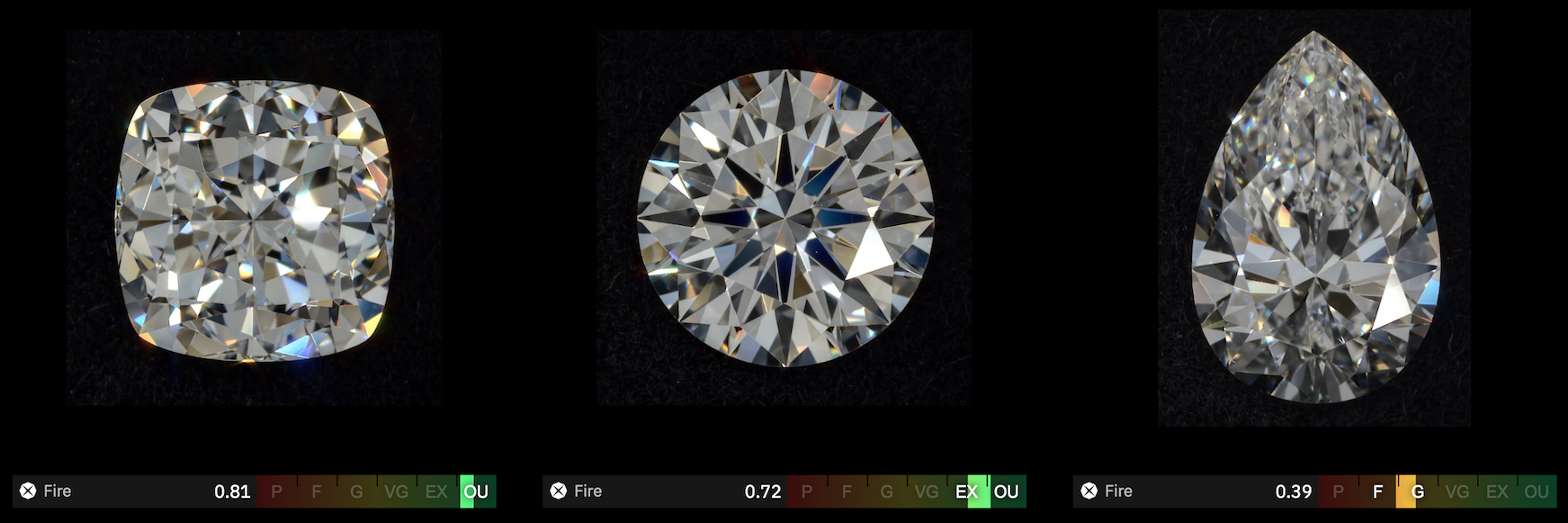
Example: https://cutwise.com/~BTrD
For more on fire and the other optical performance properties, read our Australian Gemologist article "How diamond performance attributes: Brilliance, Scintillation and Fire depend on human vision features":
Brilliance
Diamond brilliance is an illusion: the diamond looks much brighter than it actually is. This happens when a person sees several parts of an object with different brightness within one space-time domain. In a diamond, these parts are its virtual facets. Two virtual facets belong to the same space-time domain when the observer cannot see them as separate, because of the spatial or temporal limits of human vision.
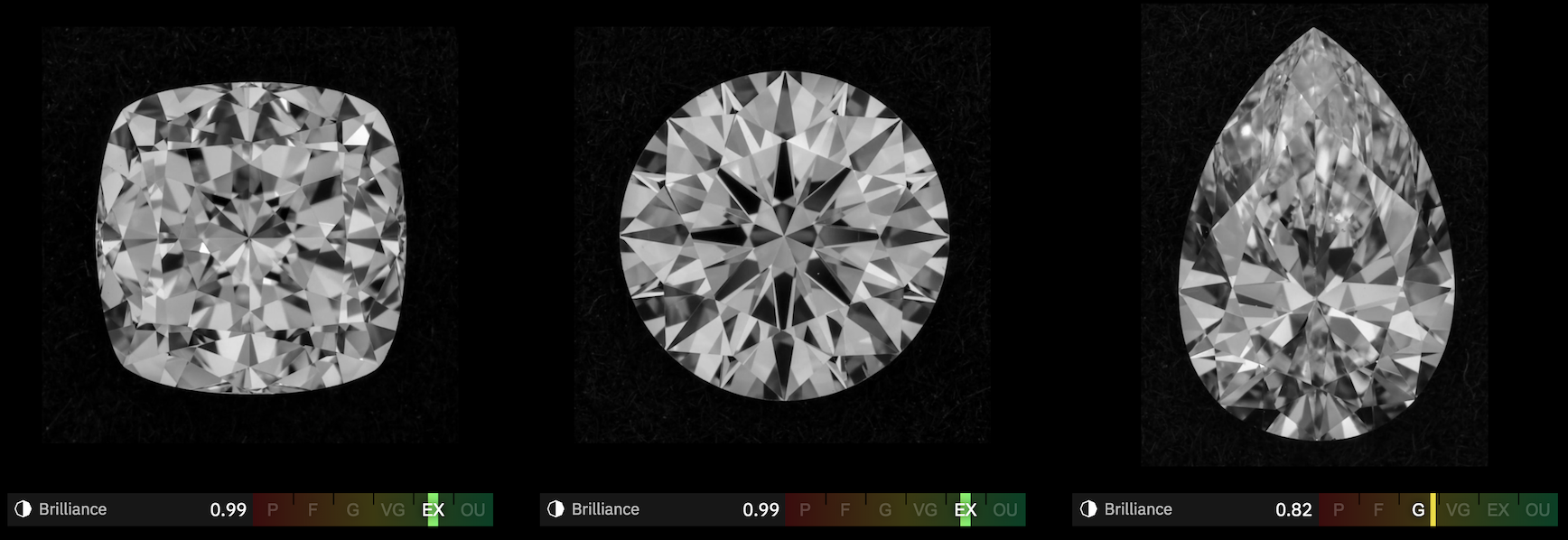
Example: https://cutwise.com/~Iesy
Cut Performance
Cut performance is a combined characteristic of a diamond, based on both fire and brilliance. It shows how vibrant the diamond is.
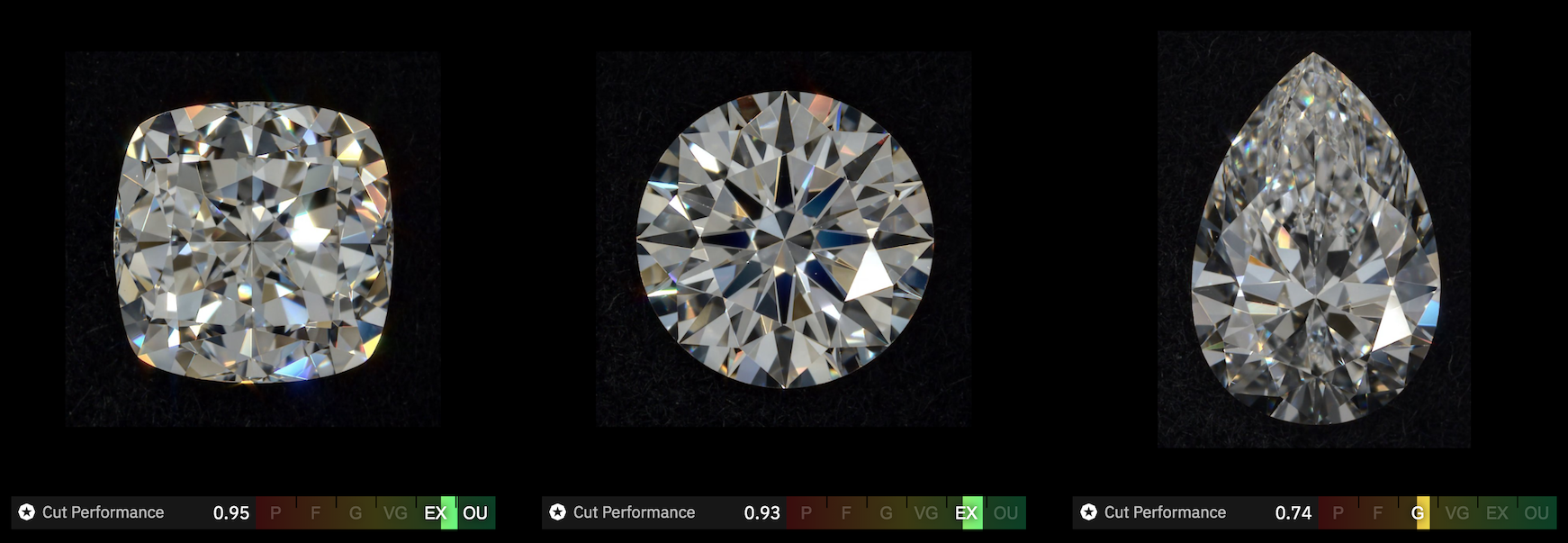
Example: https://cutwise.com/~E_gM
Optical Symmetry
Optical symmetry shows how symmetric a diamond looks face-up. For fancy shapes, the score is calculated from the crown (ASET) image. For round diamonds, the score is calculated from the crown (ASET) image and the pavilion (Hearts) image.
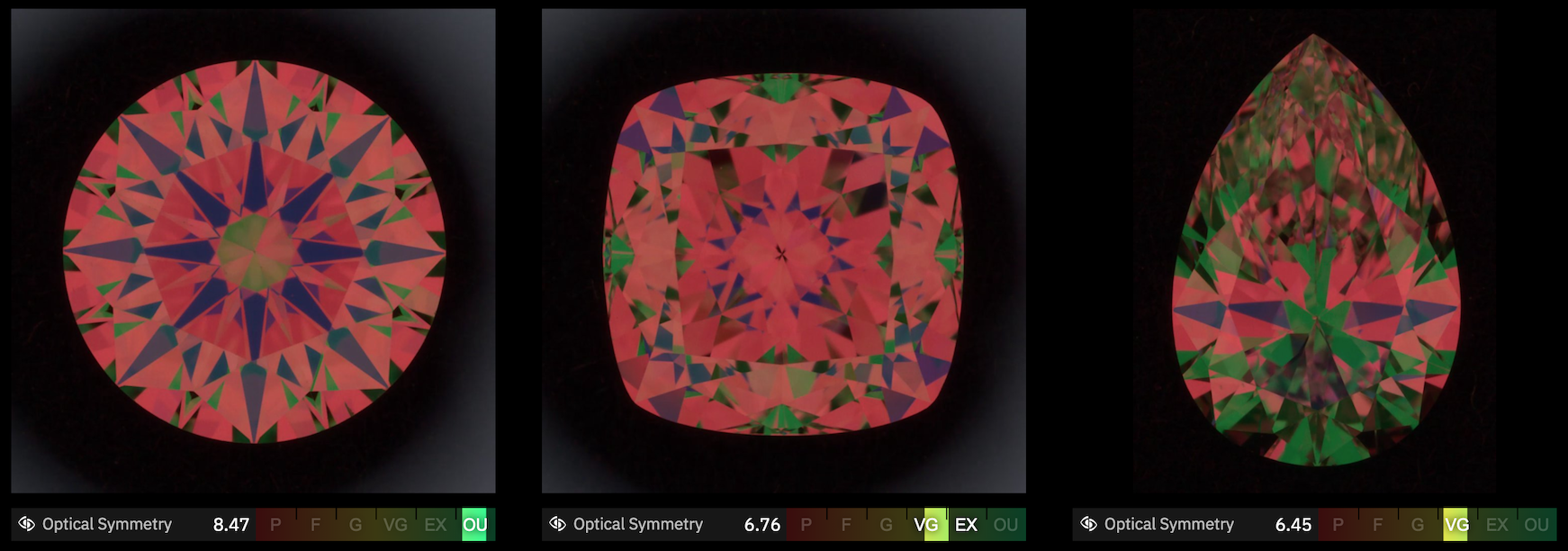
Example: https://cutwise.com/~xlRZ
Spread
Diamonds of the same weight can look different in size, depending on their shape. Spread describes this visible size. Positive spread means that the diamond looks larger than a Tolkowsky round of the same weight. Negative spread means that it looks smaller. Read more in Apparent Size.
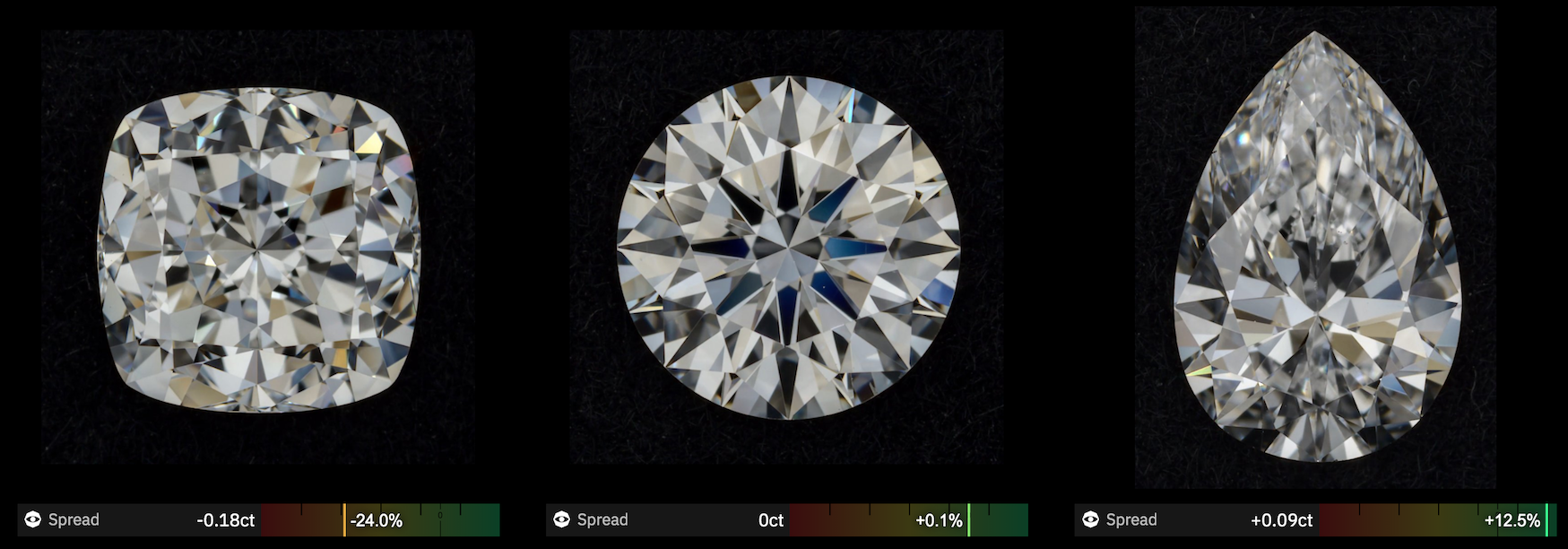
Example: https://cutwise.com/~YM2C
Fluorescence
The Face-up Fluorescence score shows the percentage of the diamond area that belongs to each fluorescence grade. It uses a face-up image of the diamond taken under 385 nm UV light.
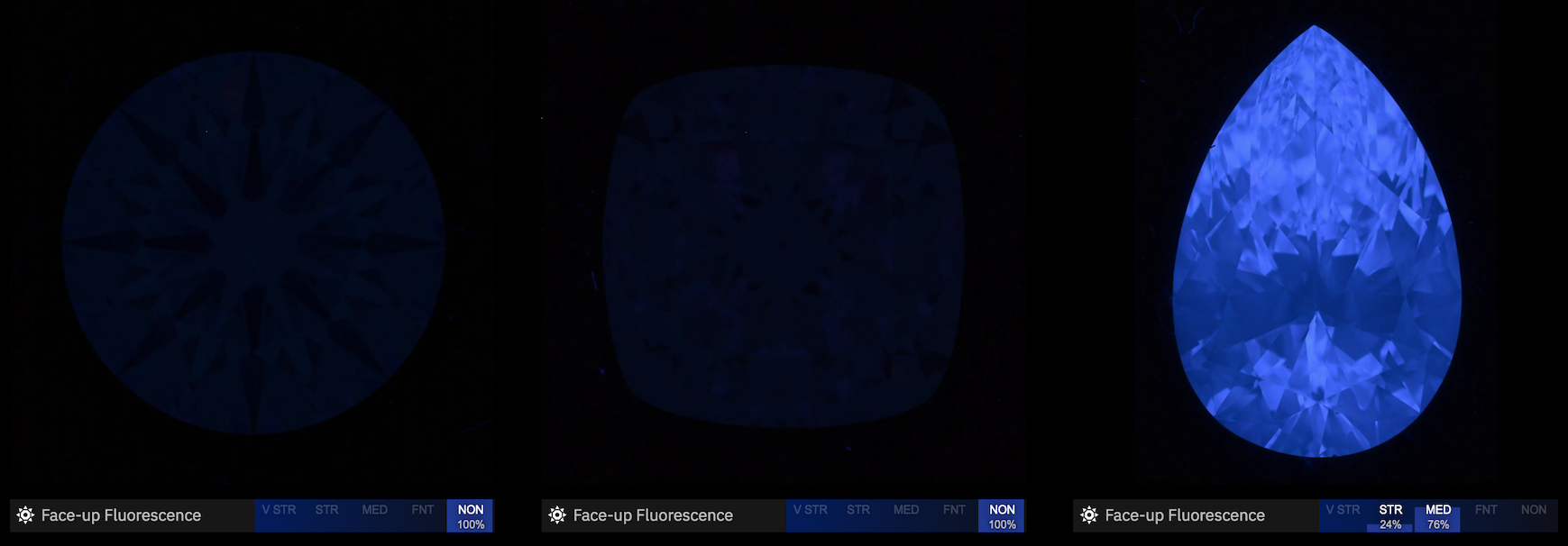
Example: https://cutwise.com/~kki_
Pavilion Fluorescence images are similar to the images that laboratories use to grade fluorescence. They are captured under 385 nm UV light.
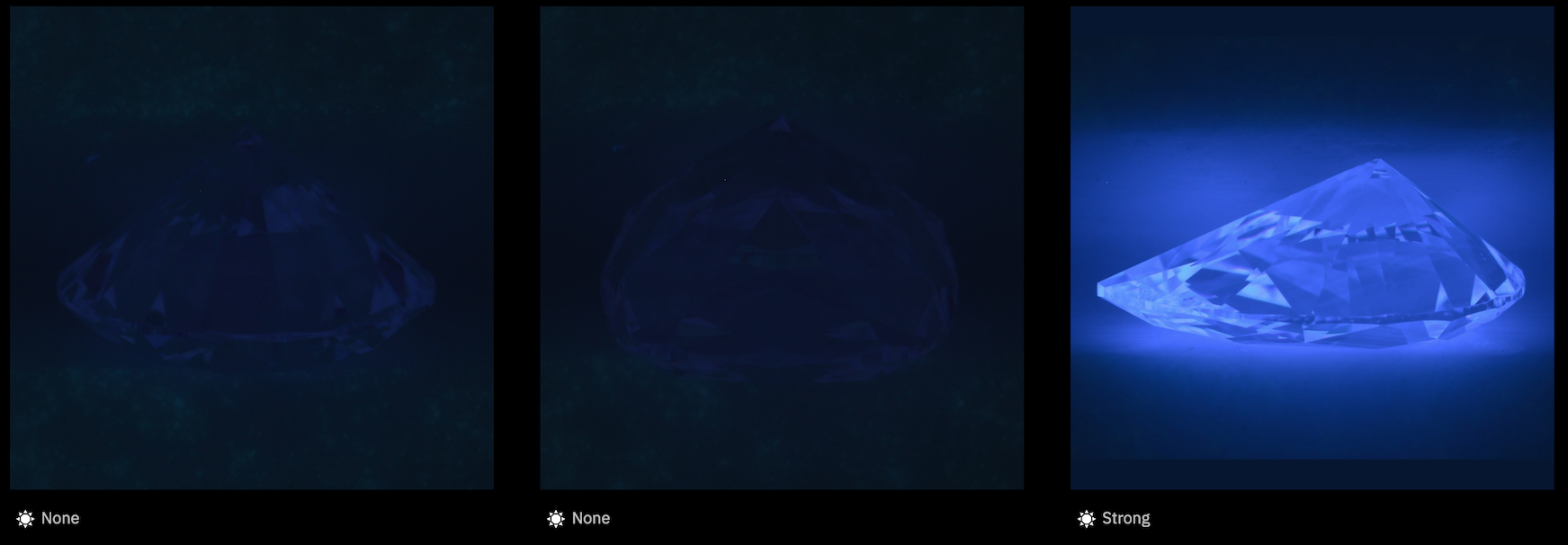
Example: https://cutwise.com/~CH1y
Optical Performance Scores in Cutwise
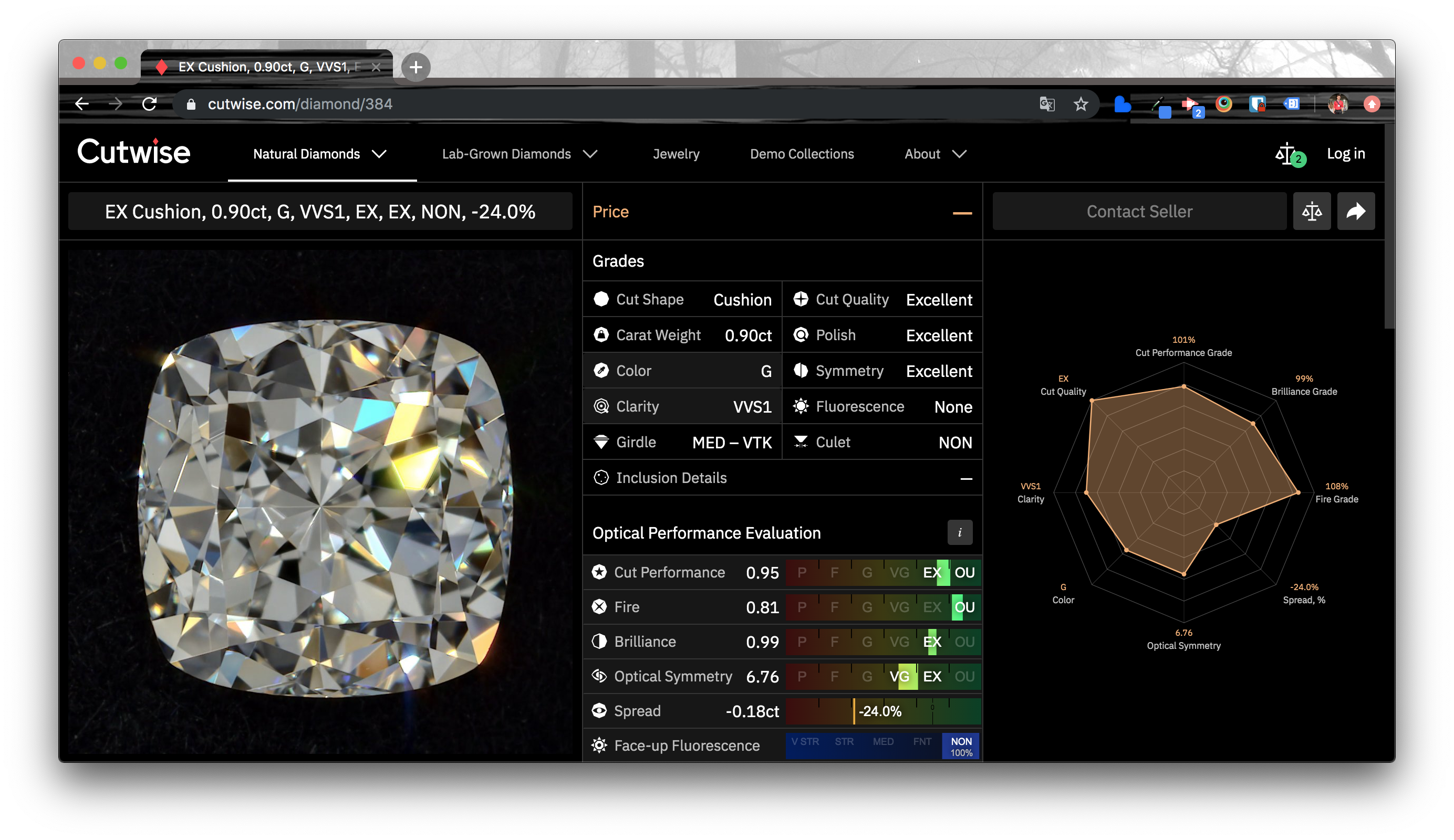
Each score has two forms:
- Absolute score (value) shows the absolute characteristic of the diamond, for example how much fire or brilliance it has.
- Relative score (grade) compares the diamond with a standard Tolkowsky round of the same visible area. It is available for Spread, Fire, Brilliance and Cut Performance.
For example:
- Fire absolute score = 1.4
- Fire score of a Tolkowsky round with the same area = 1.5
- Relative score = 1.4 / 1.5 = 0.93
The grade is calculated from the relative score. The width of the grade marker shows the accuracy of the value.
See also Optical Performance Scores in the API.